
SCR DeNOx Installation at Kozienice Power Plant (2014-2016)
Introduction
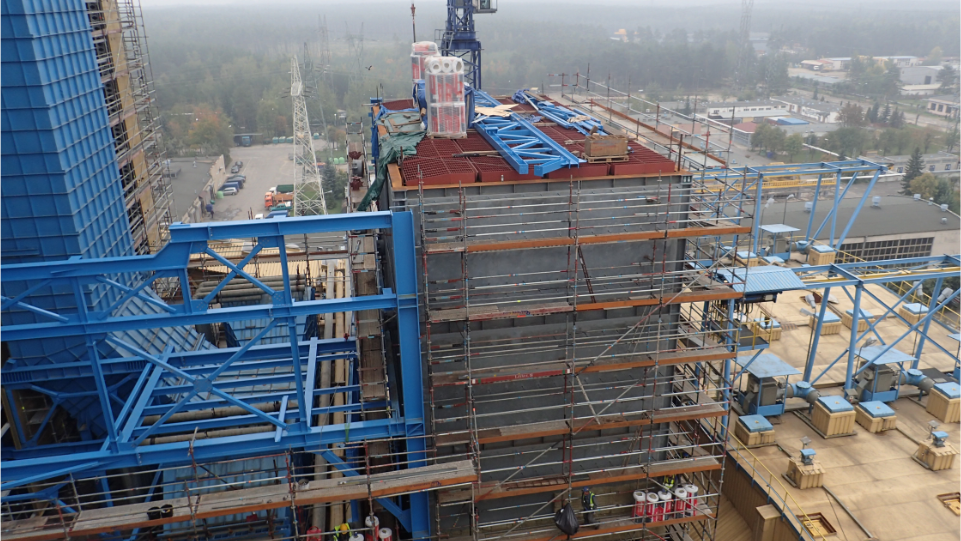
Between 2014 and 2016, Akila was involved in the delivery of a DeNOx SCR installation for Units 1 and 2 at Kozienice Power Plant, under contract with Mitsubishi Hitachi Power Systems, Ltd. The overall project covered construction, assembly and commissioning of the SCR plant, including the reactor, new flue gas ducts, economizer modernization, new IDFs, the ammonia injection system and the ash handling system.
From Akila’s perspective, this was not a narrow task. It was a large-scale installation introduced into an existing operating power plant, where technical coordination, timing and execution discipline were just as important as the technology itself.
Challenges
The main challenge was not the SCR technology on its own (that was provided by Mitsubishi Hitachi Power Systems, Ltd.), but the complexity of integrating a new installation into an existing plant environment. This kind of project does not happen in a clean, empty space. New systems have to be fitted into an active industrial context, with existing infrastructure, limited access, operational dependencies and very little margin for delay.
An important factor was the execution window. Work had to be carried out within tight time constraints, which meant the schedule was closely tied to plant availability and operational pressure. In that setting, every delay has practical consequences for the client, so keeping the project moving required goodcoordination across multiple work fronts.
A further challenge came from the natural gap between design assumptions and site reality. In modernisation projects, some adjustments only become visible during execution, when new systems meet existing structures and real construction conditions. That called for a practical, on-site approach: identifying issues quickly, coordinating the right parties, and moving toward workable solutions without losing control of the wider schedule.
Akila’s role
Akila’s involvement covered both local project management and commissioning management.
On the project management side, the scope included coordination of site works, daily and weekly meetings, supervision of works and subcontractors, project documentation management, payment milestone control, factory inspections, Technical Supervision Authorities equipment registration, translation of technical documentation, spare parts management and supplementary deliveries.
On the commissioning side, the scope included preparation of the commissioning manual, loop checks, individual equipment tests, functional tests, process tests and optimisation, performance testing, commissioning coordination, plant start-up, training of client personnel and guarantee engineer support.
In practice, this meant working at the point where documentation, construction, coordination and real start-up had to function as one process.
Delivery approach
A key part of the approach was strong on-site coordination. In a project of this type, it is not enough to monitor progress from a distance. The work has to be actively structured on site, with close attention to how mechanical, installation and commissioning activities affect one another.
Equally important was keeping information flow under control across the full delivery chain. Projects like this involve many interdependent elements: documentation, equipment, site works, inspections, formal requirements, testing and start-up. The role was not simply to oversee individual items, but to keep those elements aligned so the project could move forward without avoidable disruption.
The transition from execution to commissioning was another critical point. Rather than treating start-up as a separate final phase, the project was managed so that commissioning followed naturally from earlier coordination and preparation work.
Outcome
The result was the successful delivery and commissioning of the SCR installation for Units 1 and 2 at Kozienice Power Plant, including a broad range of related systems and activities.
More importantly, the project demonstrated the ability to coordinate a demanding technical scope under real execution pressure, while supporting the transition from construction to stable plant operation.
<REFERENCE>